











Whale-watching
20,000 gray whales just off California coast
and ready for viewing
By CARY ORDWAY
Of CaliforniaWeekend.com
 There is something magical about viewing sea creatures in their native
habitat, and maybe one of the best examples is the opportunity to watch gray whales off the California
coast. Just as predictable as Pasadena’s Rose Parade, a "parade" of some 20,000
gray whales is ready for viewing each winter in waters easily reached by tour
boats.
There is something magical about viewing sea creatures in their native
habitat, and maybe one of the best examples is the opportunity to watch gray whales off the California
coast. Just as predictable as Pasadena’s Rose Parade, a "parade" of some 20,000
gray whales is ready for viewing each winter in waters easily reached by tour
boats.
Some may have the impression that these huge mammals only travel in deep waters far from the coastline, but the reality is it’s even possible to see whale spouts from some points on land. In the San Diego area – where we spent an afternoon whale watching from a boat – the whales are just five or so miles off the coastline.
The big question for us was whether our trip would indeed yield any whale sightings. The website for San Diego Harbor Excursion has a guarantee that, if you don’t see whales, you can come back for a free trip. But, to us, that still meant there was the possibility we wouldn’t see whales and that would be disappointing since we were investing an entire weekend afternoon.
The second question was whether we would get seasick. The public relations people at the boat company made a point of warning us to take seasickness medication ahead of time if we thought we’d need it. We haven’t been seasick since, decades ago, we made the mistake of staying down below deck on a cruise through Pearl Harbor. Since then, we’d weathered hurricanes on cruise ships and sailed boats through the San Juan Islands without any recurrence…but still, we had to wonder about that strong admonition. Was this going to be particularly rough?
The great thing about whale-watching out of San Diego is that you leave from the San Diego waterfront. If you take an afternoon whale-watching cruise, that leaves the morning to do things like visit the USS Midway Museum or tour a Russian submarine, or see the sailing ship from Master and Commander. It’s also fun to grab a burger and beer at the Beach Bay Café where, coincidentally, we boarded our whale-watching tour.
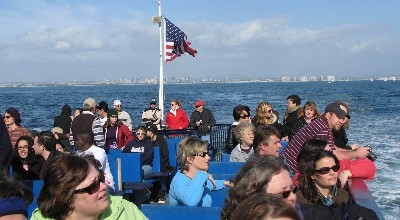
We showed up about a half-hour early for our 1:30 p.m. departure to ensure good seats on the railing of the outside decks. The 100-foot Marietta offers plenty of outdoor seating – enough, it seemed, to accommodate almost everyone on the cruise. In a pre-cruise briefing passengers were advised not to linger in the restroom – where some people apparently tend to go if they’re feeling queasy – because that will only cause more motion sickness. Then the captain offered that the morning cruise had, in fact, spotted several whales. That was the good news. The bad news was that there were four to seven-foot swells – enough to make some people sick.
 Heading
out through San Diego Harbor, a naturalist from the Birch Aquarium took the
microphone and began a three-hour narration that was packed full of information.
We had expected many details on the whales but also included were sightseeing
tips about the harbor area and San Diego in general.
Heading
out through San Diego Harbor, a naturalist from the Birch Aquarium took the
microphone and began a three-hour narration that was packed full of information.
We had expected many details on the whales but also included were sightseeing
tips about the harbor area and San Diego in general.
For example, we learned that the U.S. Navy has 30 sea lions and 80 dolphins that have been trained to help guard Navy vessels and operating areas. We had never heard of John Wayne Jetty, which stretches out from the harbor into the sea, and which got its name because Wayne hit the barrier twice with his boat in two separate years when the barrier was obscured by high tide. And did you know that Cabrillo National Monument is the second most visited National Monument in the country? Only the Statue of Liberty sees more visitors.
The naturalist’s expertise, of course, is sea life and we learned that San Diego Bay is home to the largest seahorses in the world – 12 inches long – and also to giant green sea turtles weighing 350 pounds. And we found out there are more than 4,000 pairs of the once-endangered brown pelicans in the San Diego area -- birds with a wingspan of up to 84 inches and a height of four feet.
Then, of course, it was on to a discussion about the gray whales that, between November and May, migrate 10,000 miles from their summer feeding grounds in frigid artic waters to the warm lagoons of Mexico. In November and December, they’re on their way south; the return begins in early February with the whale-watching season in San Diego ending about the end of March. San Diego, in fact, was home to the very first whale-watching tours which commenced in 1955.
After leaving the harbor, our boat began some moderate rolling in the increasingly larger swells, but we were pleasantly surprised that the Marietta seemed to handle the water just fine. We looked for any reaction from our fellow passengers, but everyone seemed to be enjoying the sunny weather with little care about the swells. The tour company had done a good job of managing expectations; the "rough" water didn’t really seem rough at all – just a little bit of movement that probably wasn’t bothering anyone who stayed up in the fresh air and followed the captain’s advice of gazing at the steady horizon or land.
At this point everyone on the boat went on alert – it was time to keep an eye
out for whale spouts. Our naturalist explained that the whales come to the
surface – emerging from the waves, then diving under the waves, then re-emerging
a few times – and then disappearing for three to five minutes before coming up
again. Sometimes they stay down for as long as 20 minutes.
We wondered who was going to yell "Thar she blows!" upon the first sighting. And then it came. Not exactly like Moby Dick, but rather a calm announcement from our naturalist that the captain had spotted a whale spout at "12 o’clock" – meaning straight ahead of the boat. Passengers moved forward to get a look and, sure enough, there it was in the distance: a spout that, on land, might be confused with the Old Faithful geyser.
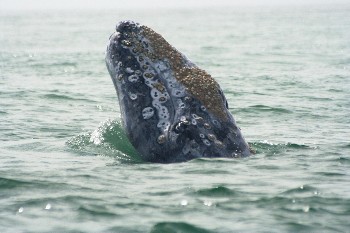
Soon, nearby boats were joining us as we moved closer to get a view of the giant mammal breaching the water, then slicing its way through the waves with its barnacle-covered back clearly visible to the elated passengers. Once the whale had been underwater several minutes, our boat moved on and quickly spotted more spouts on both sides of the boat. There were spouts at "10 o’clock" then "2 o’clock" and on it went to the point that the naturalist admitted there were more whales visible on this day than most. There was never more than a few minutes before another spout was spotted. Some were quite distant, but all were visible from the boat. In between whale appearances, schools of dolphins were flying from wave to wave on both sides of our boat. Occasionally a sea lion or seal would wander by.
The gray whales are up to 45 feet long and weigh 30 tons so you might think it would be easy to get good pictures. The reality is that you really need a high-powered telephoto lens and a little bit of luck to catch one with a good part of its body above the water. Most times we could see the back and barnacles, but we only saw the classic tail fins on one or two occasions. It also should be noted that responsible whale-watching companies observe strict rules about not getting too close to the whales or in any way agitating them.
But overall, for us, this turned out to be a very successful day: not only did we enjoy numerous whale sightings, but we left our lunch in our tummies right where it belonged.
AT A GLANCE
 WHERE:
San Diego Harbor’s one of several locations along the California Coast that
offer whale-watching trips.
WHERE:
San Diego Harbor’s one of several locations along the California Coast that
offer whale-watching trips.
WHAT: Whale-watching is a great combination of an enjoyable cruise on the ocean and some truly spectacular natural scenery.
WHEN: Whale-watching season in San Diego runs from approximately December through the end of March. This time of year can be chilly on the water, even in San Diego, so be sure to dress warm – you’ll probably be spending most of the cruise out on the deck.
WHY: Whale watching is fun for the entire family and educational, too.
HOW: For more information on San Diego whale-watching, please visit www.sdhe.com or phone 619-234-4111.
Photos by Cary Ordway, Sandi Ordway
Captions, from top: Gray whales are visible just a few miles off San Diego coastline (whale photos courtesy Jeff Talsky, Birch Aquarium); open decks allow for plenty of outdoor seating; naturalist (in hat) shows passengers barnacles and other sea life; San Diego waterfront is always fun and festive
Please visit California Weekend for more information on California travel .
Photo credits: Cary Ordway, Sandi Ordway
About California | California Hotels and Resorts | California Attractions | California Art and Entertainment
California Restaurants and Dining | Shopping | California Real Estate
California Visitor Information | California Calendar of Events | Visit California Online Home Page

all contents copyright © ci-Interactive
design and programming by ci-Interactive